How to Write Instagram Captions for Restaurants That Actually Get Clicks

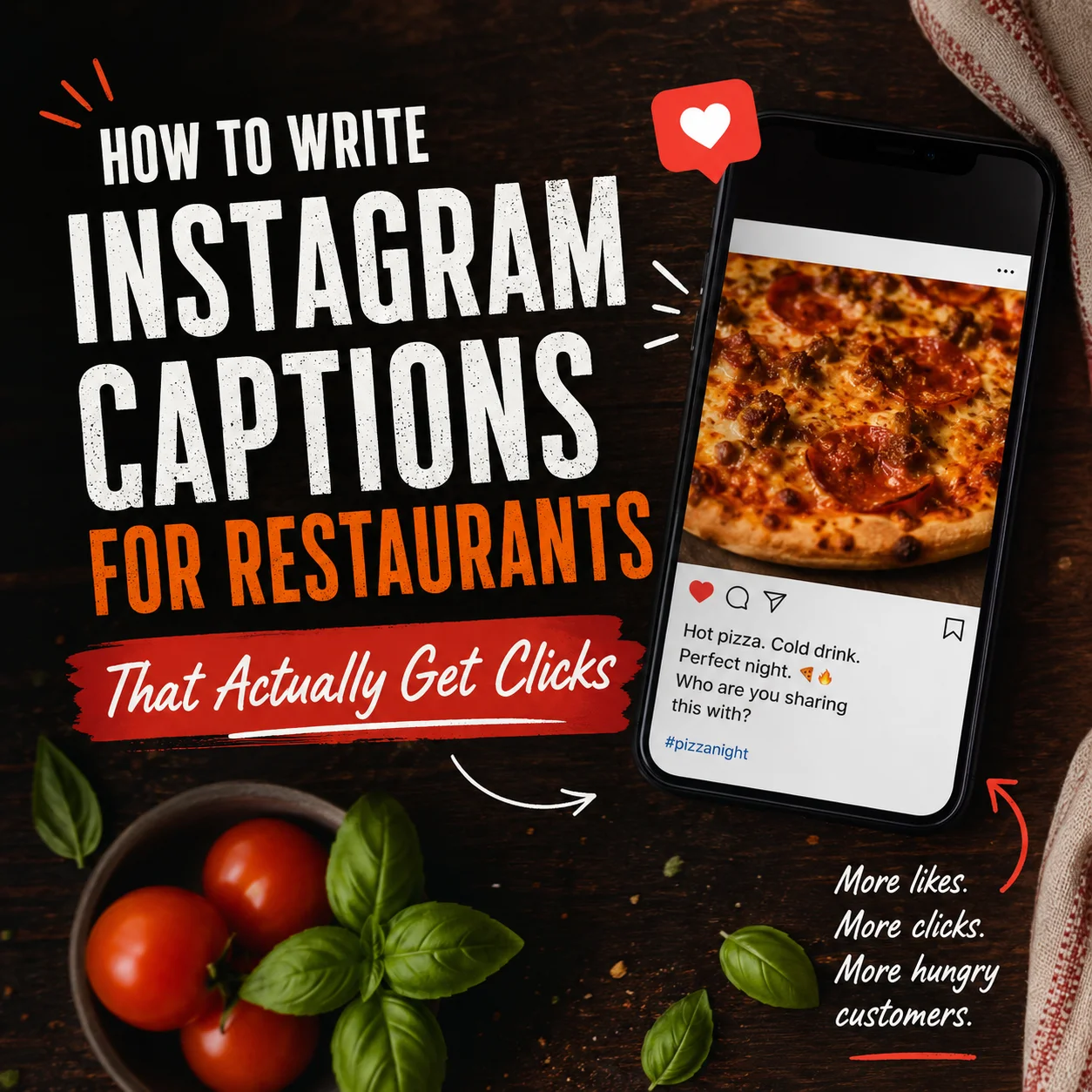
"Tonight's special: grilled salmon with roasted vegetables. Come try it!" That's a real Instagram caption for restaurants, sitting under half the food photos on the platform right now, and it's doing nothing. It reads like a menu insert, not an invitation. If you're trying to get better at Instagram captions for restaurants, the fastest fix starts with breaking that exact habit.
Why Most Restaurant Captions Get Ignored
Here's the mistake almost every restaurant makes: they write captions that describe the dish. Grilled salmon. Roasted vegetables. Fresh basil. Made in-house. All true, all pointless, because the photo already told people what's on the plate. Nobody needs the caption to repeat it.
Instagram users aren't reading a menu. They're scrolling a mood. Someone's thumb is moving past a hundred other posts, half of them food, and your caption has about two seconds to do something the photo alone can't: make them feel a pull toward walking into your restaurant tonight instead of ordering the same delivery app dinner they always get.
A caption that informs says "here's what this is." A caption that converts says "here's what you're missing." That's the entire gap between restaurant Instagram captions that get scrolled past and ones that get someone tapping "book a table" before they've even finished reading.
This isn't just a hunch. Sprout Social's research on Instagram captions notes that while the platform allows captions up to roughly 2,200 characters, shorter and punchier consistently outperforms a wall of text. A restaurant caption doesn't get graded on how much it explains. It gets graded on how fast it lands.
The Three Things a Good Restaurant Caption Does
Forget the word "framework." Think of it as three jobs a caption has to clock in and do, every single time.
First, it makes them feel something. Hunger, obviously, but also nostalgia, warmth, or the fear of missing out on something everyone else is already enjoying. A caption under a photo of short ribs that says "this is the dish regulars order without looking at the menu anymore" does more work than any description of braising time ever could.
Second, it gives them a reason to act now, not eventually. A limited special, a dish that's only on the board today, a table that's filling up fast on a Friday. "We're down to the last of tonight's burrata, first come, first served after 7" moves faster than "our burrata is made fresh daily."
Third, it tells them exactly what to do next. Reserve a table. Order online. DM the word "yes" and you'll hold a portion. Restaurants lose customers at this exact step constantly, not because the caption failed to sell the dish, but because it never told anyone what to do after they got hungry.
Caption Formulas That Actually Work for Restaurants
These aren't templates to copy word for word. They're structures you fill in with your own dish, your own night, your own kitchen. Steal the shape, not the sentence.
The Sensory Opener. Lead with what it smells or tastes like before you ever name the dish. Structure: [sensory detail], then [name of dish], then [why tonight]. Example: "The smell hits you before the plate does, charred garlic and brown butter rolling off the pan. Our short rib ragu is back on the menu tonight, and we only made enough for one seating."
The Scarcity Play. Structure: [what's limited], [how limited], [what happens if they wait]. Example: "We made 14 orders of the burnt honey cheesecake tonight. Last time we posted it, it was gone by 8:15. Come early or comment and we'll set one aside."
The Story Hook. Structure: [the accident or origin], [what it became], [invitation to try the result]. Example: "This sauce started as a mistake, a line cook doubled the chili paste on a Tuesday and nobody caught it until the pass. We kept the mix. It's now our most-ordered noodle dish, and it's on the board through the weekend."
The Direct Ask. Structure: [state the offer plainly], [give a one-word action]. Example: "We made 20 of these today. Comment WANT and we'll save you one before the dinner rush eats through them."
The Regulars' Secret. Structure: [what insiders already know], [invite outsiders in]. Example: "Regulars know to ask for the off-menu spicy version of the mussels. Tonight, we're putting it on the board for everyone."
Notice none of these describe the food the way a menu would. They all put the reader inside a moment: the smell in the kitchen, the countdown on a limited batch, the mistake that became a hit. That's what separates a caption for restaurant Instagram posts that gets skimmed from one that gets someone reaching for their phone to book a table.
A Real Example: What Bad Looks Like vs What Works
Before: "Wednesday Pizza Special! Large pizza $12.99, 4-9pm. Come on by!"
After: "Wednesday just became the best night of the week. Any large pizza, any toppings, $12.99. Every Wednesday, 4 to 9 PM. 🍕 Tag whoever you're splitting this with. #pizzanight #wednesdayspecial #pizzadeal #pepperonipizza #pizzalover"
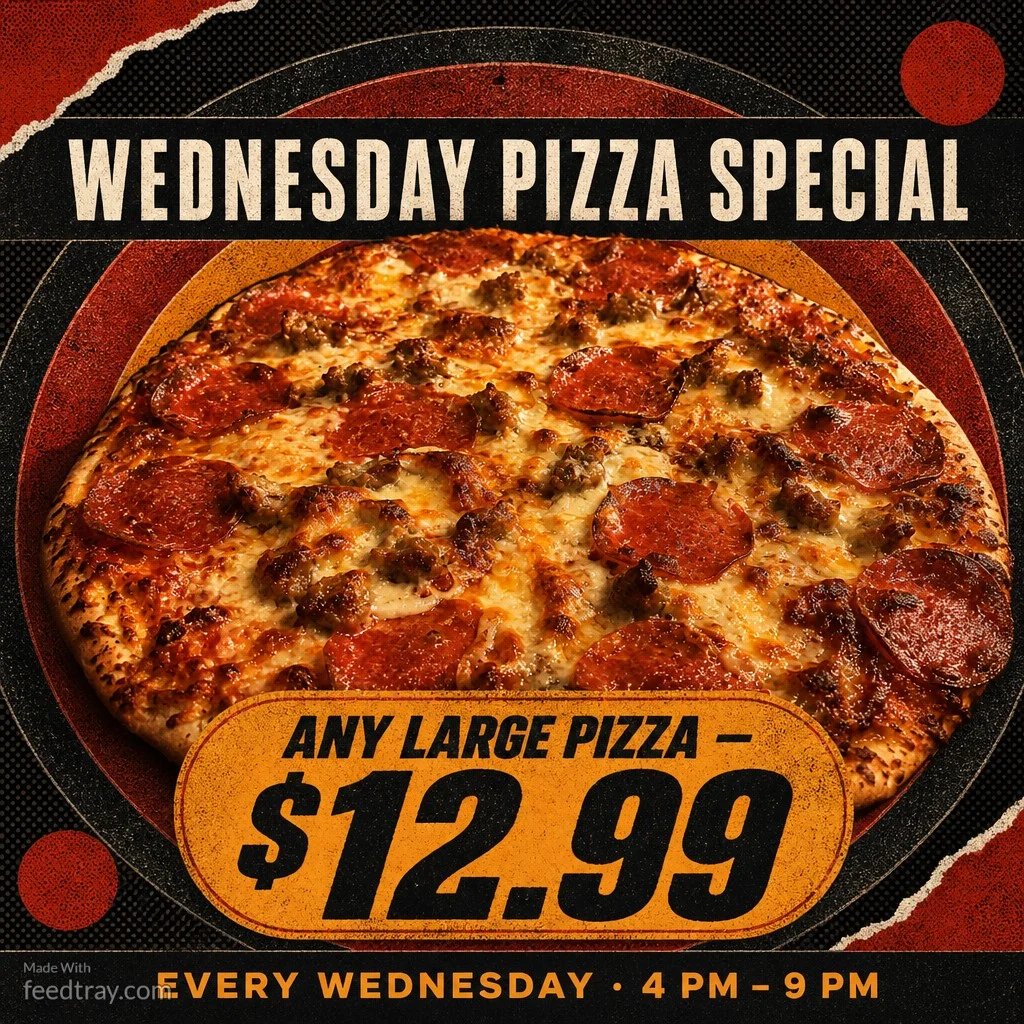
riversidegrill Wednesday just became the best night of the week.
Any large pizza, any toppings, $12.99. Every Wednesday, 4 to 9 PM. 🍕
Tag whoever you're splitting this with.
The before caption is a flyer. The after caption is an invitation. Same deal, same $12.99 price, same hours, but one of them gives the reader a reason to tag a friend and turn one post into two people walking through the door.
The Part Nobody Tells You About Writing Captions
Instagram cuts off captions after two or three lines and hides the rest behind "more." Whatever you write after that cut doesn't exist to most people scrolling past. So the entire caption lives or dies on the first sentence.
That first line has to earn the tap. A few ways to do it, all applied to a restaurant context instead of generic advice:
A question: "Ever wonder why the line for our brunch wraps around the block by 9am?" This works because it puts the reader on the outside of something other people already know, and the only way to find out is to keep reading or show up. A restaurant lives or dies on word of mouth, and a question like this borrows that same social pressure without needing an actual line of people.
A bold claim: "This is the only pasta on our menu that takes four hours and zero shortcuts." A claim this specific reads as a dare. It invites someone to disagree or find out for themselves, and either reaction gets them to tap "more." It also does something menus rarely do, it tells the reader this dish took real effort, which matters more to a customer deciding between your restaurant and a delivery app than any description of the sauce.
A sensory detail: "The garlic hits the pan and the whole kitchen stops what it's doing." This one works because it puts the reader inside the kitchen instead of at the table looking at a finished plate. Most restaurant marketing only shows the result. A line like this sells the process, and process is what makes a dish feel handmade instead of assembled.
A number: "We've sold out of this dish 11 Fridays in a row." Specific numbers read as proof, not marketing. A vague claim like "our most popular dish" can be said by any restaurant on any street. Eleven Fridays is a fact someone has to reckon with, and facts are harder to scroll past than adjectives.
Any of these earns the tap. "New dish available today" does not, because it gives someone nothing to be curious about. Curiosity is the whole mechanism. If the first line answers everything, there's no reason to read line two.
How to Write a Week of Captions in 20 Minutes
The owners who seem to effortlessly post great captions every day aren't writing them fresh each time. They're batching.
Keep a running note on your phone, the same one you use for prep lists or ordering. Every time something happens during service worth mentioning, a dish sells out, a regular says something quotable, a mistake turns into a new favorite, jot down one line. By the end of a busy week you'll have five or six raw ideas sitting there, and writing captions becomes filling in a formula instead of staring at a blank text box at 11pm. If you haven't fixed the photos those captions sit under yet, how to take better food photos for Instagram walks through the most common food photo mistakes worth solving first.
One strong caption can also stretch across a week with small changes. A story hook about a dish's origin can become a scarcity play three days later when you're running low on it, then a direct ask when you want to clear the last portions before the weekend.
This is also where Feedtray fits in without adding another task to your night. After you enhance a food photo, Feedtray writes a caption for it in the same step, one built around the actual dish in the photo instead of a generic template. It's less about replacing the thinking above and more about handing you a strong starting point so you're editing a caption instead of inventing one from nothing at close.
Writing good captions is a skill, and like any kitchen skill, it gets faster every time you do it. The owners with the best Instagram captions for restaurants didn't take a course or hire a copywriter. They just stopped describing the plate and started selling the feeling behind it.