How to Get More Food Truck Customers From Instagram

You're parked at a corner that should be printing money. The flat top is hot, the food is ready, and the lunch rush walks straight past your window. You posted this morning, you tagged the location, and you still can't figure out how to get more food truck customers from Instagram when the proof that you exist is sitting right there on their phones.
Why Instagram Is More Important for Food Trucks Than for Any Other Food Business
A restaurant has a fixed address. It has a Google Maps pin, a sign over the door, and regulars who drive past it every day on the way to work. Even on a slow week, the building is still there reminding people it exists.
A food truck has none of that on a consistent basis. Monday you're outside the office park. Wednesday you're at the brewery. Saturday you're at the farmers market across town. Your customers can't find you by memory, so they find you by checking your account.
That makes your food truck Instagram three things at once. It's your address, because it tells people where you're parked today. It's your menu board, because it shows what's coming off the grill. And it's your open sign, because a fresh post at 9:30 says you're rolling and ready.
When a restaurant's Instagram is weak, it loses some engagement. When a food truck's Instagram is weak, it loses actual people at the window, every single day. The regular who would have walked over doesn't know you're two blocks away. The new customer who might have tried you never sees a reason to. Instagram for food trucks isn't branding. It's the difference between a line and an empty curb.
The Three Things Your Food Truck Instagram Needs to Do Every Day
Every daily post has three jobs: tell people exactly where you are, show them what's worth eating today, and give them a reason to come now instead of later. Most trucks do the first job badly and skip the other two entirely.
Job 1: Tell them exactly where you are
"Out today" isn't a location. Neither is a city name in the location tag. A hungry person on their phone needs a street corner, a landmark, and a closing time, or they won't bother looking.
Weak version:
Out and about today! Come see us 🌮 #foodtruck #tacos #eatlocal
Strong version:
Parked on 5th and Main today, right outside the Hartley Building, 11am to 2pm. Orange truck by the bike racks. You can't miss us.
The strong version answers every question before it gets asked. Nobody has to DM you. Nobody has to guess.
Job 2: Show them what's worth eating today
Your followers have seen your menu. What they haven't seen is why today is different. Name one specific item and describe it like you're standing at the window handing it over.
Weak version:
Tacos, burritos, quesadillas, all the good stuff. Come hungry!
Strong version:
Birria is back. Beef braised for eight hours, tortillas crisped on the plancha, a cup of consommé for dipping. We made 80 orders and that's it.
One item, described with real detail, beats a menu recap every time. The reader can almost taste it, and "80 orders" quietly tells them it won't last.
Job 3: Give them a reason to come now
This is the job almost every truck skips. Without it, a follower thinks "maybe later" and later never happens.
Weak version:
Open till 2! See you there.
Strong version:
Line is short right now. By 12:15 it won't be. Birria sold out by 1pm last Thursday, so don't wait on this one.
Urgency only works when it's true. Don't fake it. If something really did sell out last week, say so. If the line really is short, say that too.
All three jobs in one caption
Birria is back. Beef braised eight hours, crispy edges off the plancha, consommé for dipping. Parked at 5th and Main outside the Hartley Building, 11am to 2pm, orange truck by the bike racks. We made 80 orders and it sold out by 1pm last time. Come early.
Four sentences. Where, what, and why now. That caption does more for food truck customers than a week of hashtags. For more on writing captions that turn a scroll into a visit, see how to write Instagram captions for restaurants that actually get clicks.
Why Your Food Truck Photos Are Losing You Customers
Food truck food is harder to photograph than restaurant food. A restaurant plates on clean white ceramic under warm, controlled light. You're serving out of paper boats, red-checked baskets, and foil wrappers. Your light is whatever the sky gives you, which at noon means harsh shadows and blown-out highlights. And your background is a steel counter, a ketchup pump, and a stack of napkins.
The shooting environment works against you before you even pick up the phone. Then you snap the photo between orders, with three people waiting, and post it as it is.
That is the whole problem, and it matters more for you than for any restaurant owner, because your photo is not background noise. It is the entire case for why someone should walk three blocks right now. A restaurant photo asks someone to book a table sometime. A food truck photo asks someone to walk three blocks or drive across town right now, based on that one image alone. There's no menu to browse, no Yelp page they've already read, no building they've walked past a hundred times. The photo is the whole pitch.
When the taco looks gray and flat in a soggy paper boat, the scroller doesn't think "bad lighting." They think "probably not worth the walk." And they keep scrolling.
You can improve a lot by shooting in shade, getting close, and clearing the clutter out of frame. The guide how to take better food photos for Instagram covers the basics. But on a busy service day, you won't always have time to get it right.
How to Build a Food Truck Instagram That Keeps Customers Coming Back
One great post gets you one good day. Consistency is what turns followers into regulars who check your account before they decide where to eat lunch.
Post the location at the same time every morning
Pick a time and stick to it. If your location post goes up at 9:30 every service day, your regulars learn to check at 9:30. Lunch decisions in an office happen between 10 and 11:30, so a 9:30 post lands right before people start planning. Posting at 11:50 means most of them have already decided.
Use Stories for real-time updates
Your feed post is the plan. Stories are what's happening right now. Post a quick Story when the line clears, when you're down to the last 10 orders of a special, or when you're running 15 minutes late because the generator wouldn't start. Those updates make people feel like insiders, and they convert "maybe" into "I'm going now."
Save locations as Highlights, organized by neighborhood
Create a Highlight for each regular spot: Downtown, Brewery Row, Eastside Market. When someone wants to know if you ever come to their part of town, they tap the Highlight and see the answer in two seconds. Instagram explains how Highlights and the Stories archive work on its Business blog.
Pin the weekly schedule
Post your full week every Monday and pin it to the top of your profile. Days, spots, hours. A new visitor who lands on your profile on a Thursday shouldn't have to scroll through a week of posts to find out where you'll be Friday.
Post on your days off
When your account goes quiet for three days, followers start wondering if you closed. A short post on an off day keeps you in their feed: prep for tomorrow's special, a new sauce you're testing, the truck getting washed. It tells people you're still rolling, and it builds appetite for your next service.
What the Difference Looks Like
A food truck customer makes a decision based on one photo: is this worth walking three blocks or driving across town for, right now? The photo either answers yes or it doesn't. Here's the same plate of tacos, twice.
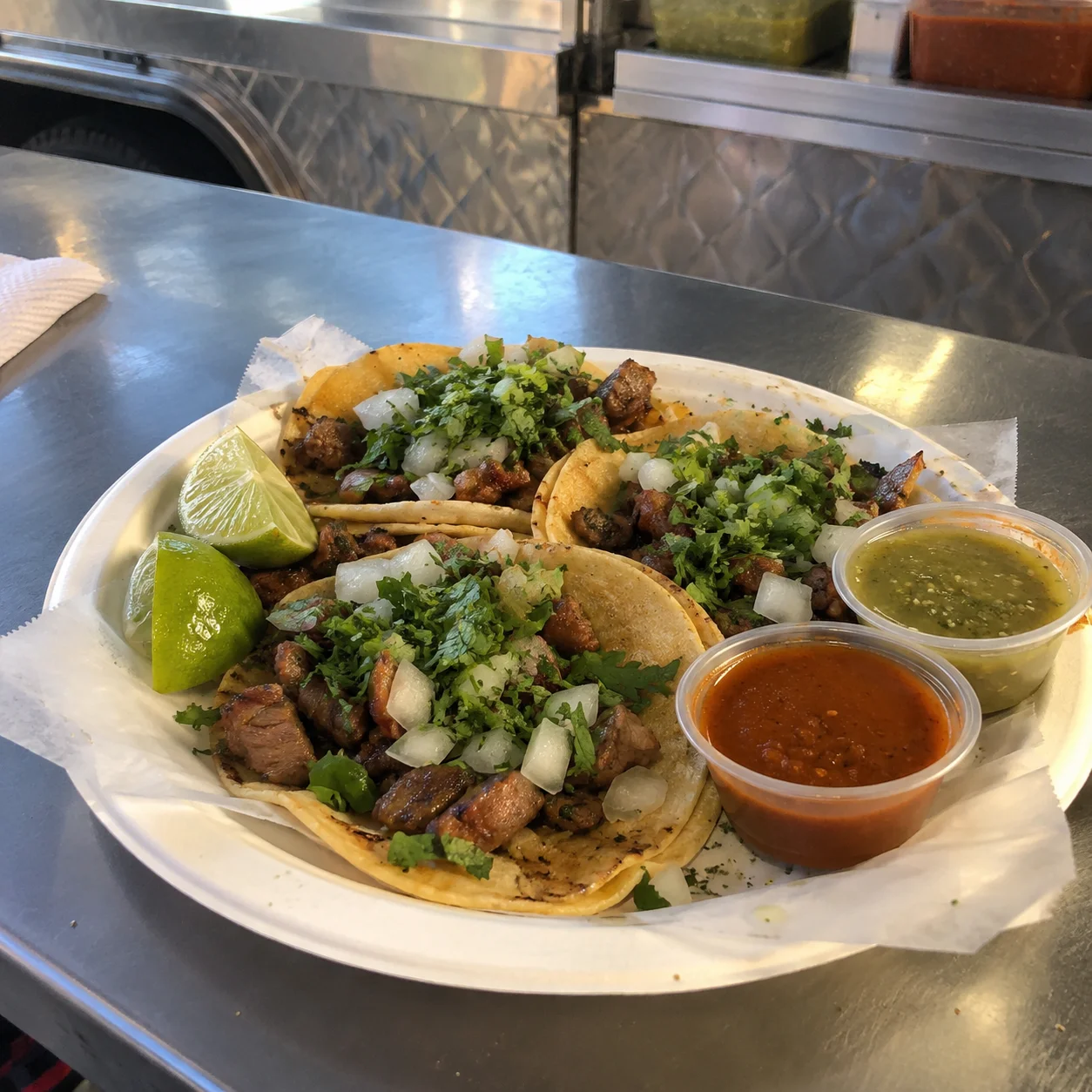
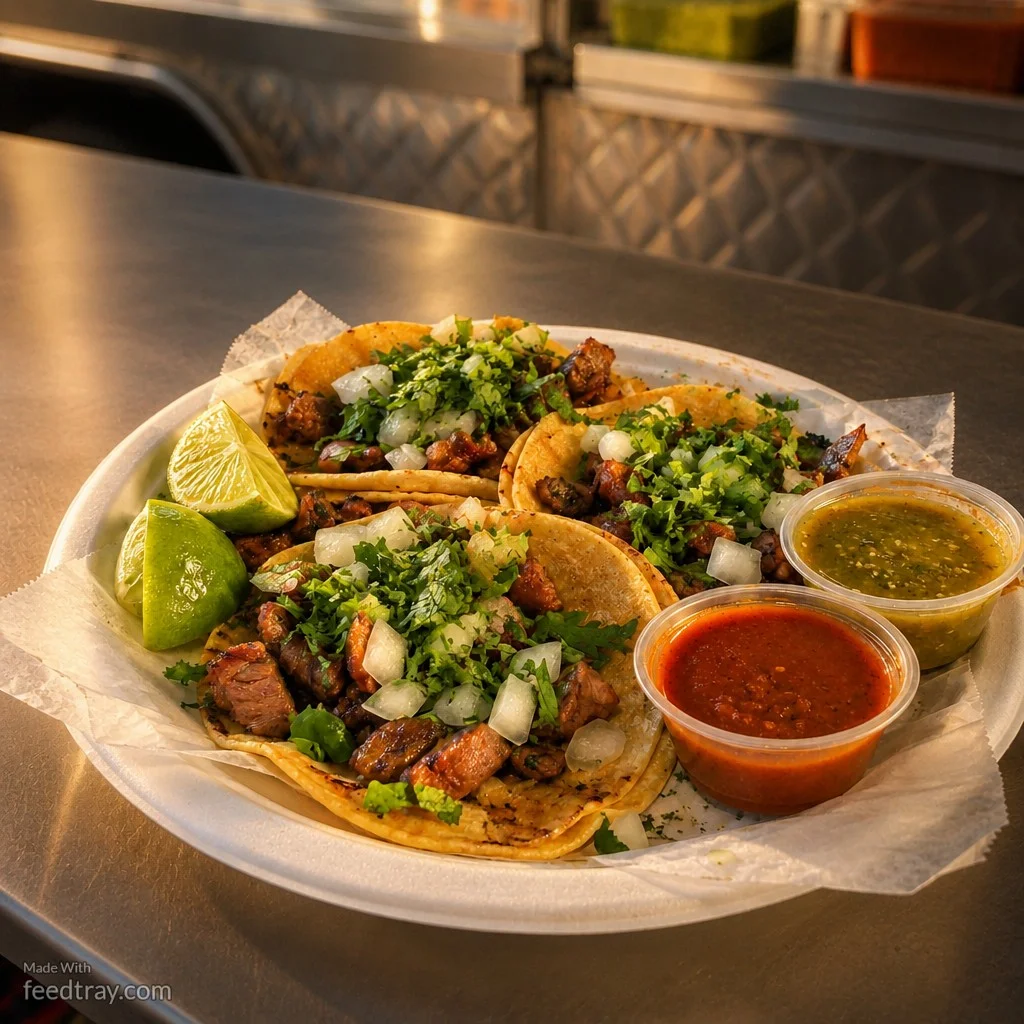
Before and after street taco photo enhanced with Feedtray showing how to get more food truck customers from Instagram
This is the photo that makes someone check the location tag and start walking.
How Feedtray Fixes the Food Truck Photo Problem
Feedtray was built for exactly this situation: good food, a bad shooting environment, and no time to fix it. You're working a truck window with orders stacking up. The sun is straight overhead. The background is a steel counter and a squeeze bottle.
So you take the photo on your phone like you already do. Upload it to Feedtray, tap once, and the lighting is corrected, the background is cleaned up, and the color is fixed. It takes about 30 seconds, right from your phone, between tickets.
It's still your real taco. Feedtray doesn't swap your food for an AI-generated stand-in. The char on the meat, the salsa you made at 6am, the tortilla you pressed by hand: all of it stays. It just looks the way it looked when you handed it through the window.
That means your 9:30 location post goes out looking like something worth driving to.
Every day your truck posts a weak photo with a vague location is a day of customers who saw the post and kept walking. They were hungry. They were nearby. They just didn't get a reason to come. Your food truck Instagram isn't a scrapbook. It's a daily tool for getting people to your window today, and it works when the post says where you are, shows food worth the trip, and makes waiting feel like a mistake.